


EUDR 2026
Think you've got time? Think again. You're already behind.
By 30 December 2026, non-compliance could mean blocked shipments, hefty fines and costly disruption. How ready is your supply chain?
Time remaining
Meeting EUDR requirements means collecting data across your entire supply chain, tracing the origin of raw materials and managing Due Diligence Statements (DDS). With the compliance deadline fast approaching, time to prepare is running out.
What are the Consequences?
Penalties of up to 4% of annual turnover, goods held at customs, serious operational disruption.
In a regulatory landscape this complex, a standalone solution simply isn’t enough. An integrated approach is essential. Tesisquare brings every stage of EUDR compliance together in one platform. Automate traceability, simplify communication with European authorities and stay compliant with confidence.
The Challenge
Why is EUDR a real challenge for businesses?
Many organisations have little or no visibility beyond their first tier of suppliers.
The EUDR introduces specific operational obligations, including:
Data collection across multi-tier supply chains
Traceability back to the farm or forest of origin
Verifying deforestation risk
Managing Due Diligence Statements (DDS) through TRACES
Which sectors are covered by the EUDR?
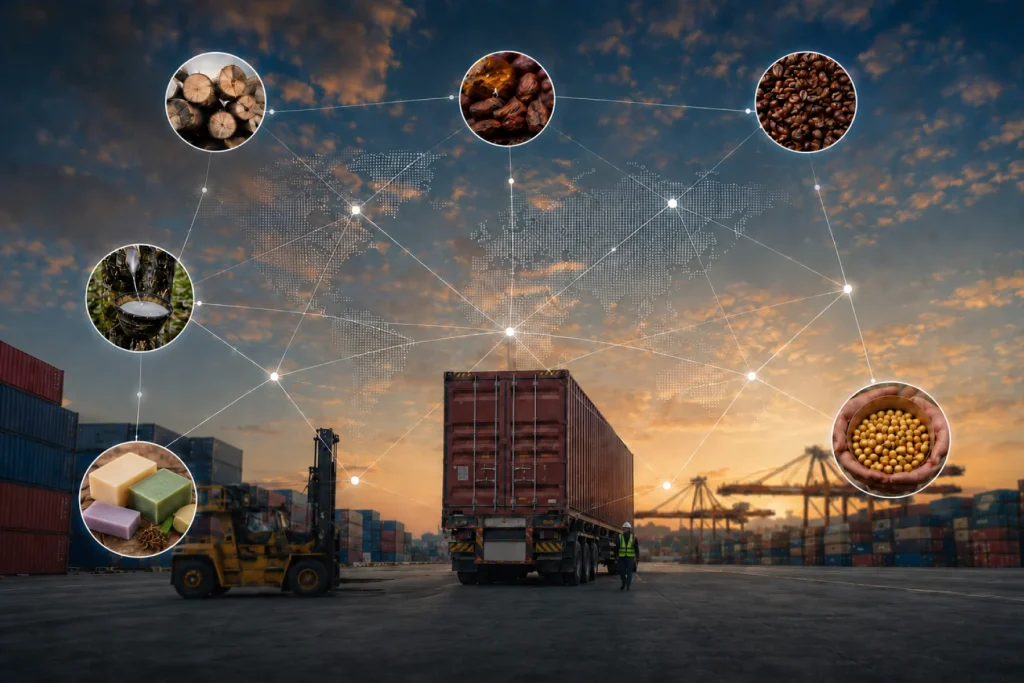
If your business uses, processes or distributes commodities or derived products associated with deforestation, the EUDR introduces strict traceability and due diligence requirements.
The regulation applies to:
Timber and wood products
Paper and pulp
Natural rubber
Soaps and oleochemical derivatives
Coffee
Cocoa
Palm Oil
Soy
30 December 2026
Compliance deadline for medium-sized and large enterprises
30 June 2027
Compliance deadline for SMEs
Up to 4% of annual turnover
Potential penalties for non-compliance
The TESISQUARE Platform: One platform. Complete EUDR compliance, end-to-end.
There’s no need to start from scratch. Tesisquare is built on an established network of suppliers and partners, helping you accelerate compliance from day one.
Map your supply chain all the way back to the source
Automatically collect and verify supplier data
Assess deforestation risk using satellite intelligence
Ensure complete batch and product traceability
Business benefits
Reduce the risk of fines of up to 4% of annual turnover
Keep goods moving and minimise supply chain disruption
Centralise data and processes in a single platform
Gain end-to-end visibility across your supplier network, including indirect suppliers
Turn compliance into a competitive advantage
Guarda il webinar EUDR on demand
Scopri attraverso una demo reale come digitalizzare la compliance EUDR, gestire la due diligence e collaborare con fornitori e partner in un’unica piattaforma.
45 minuti
Accesso gratuito

Trusted by


Take control of EUDR compliance before it becomes an operational challenge
Start today with a structured, scalable approach designed to support your business now and as regulations evolve.
Frequently Asked Questions About the EUDR
Scope of Application, Products, and Penalties
Which raw materials and products are subject to the EUDR?
The EUDR (EU Regulation 2023/1115) applies to 7 basic raw materials: cattle, cocoa, coffee, palm oil, natural rubber, soy, and wood. The regulation covers the related derivative products expressly listed in Annex I, including chocolate, cocoa mass, cocoa butter, and coffee; wooden furniture, paper, and cardboard; wood pulp; wooden packaging (if marketed as a separate product); firewood and charcoal; new tires made of either natural rubber or a blend of natural and synthetic rubber; inner tubes; conveyor belts; and protective rubber clothing; fresh or frozen meat, offal, as well as leather and hides—whether raw, tanned, or treated—of bovine origin, and oleochemical products such as soybean oil, soybean meal, palm oil (and its fractions), palm kernel meal, and specific industrial oleochemical derivatives (such as glycerol, palmitic acid, and stearic acid).
What is excluded? Products that do not fall under the customs codes listed in Annex I are not subject to the regulation. Examples of excluded products are textiles made from natural fibres (such as cotton and linen), margarine (even if produced with palm oil), and products made entirely from recycled materials that have reached the end of their life cycle and would otherwise be disposed of as waste.
Source: EU Regulation 2023/1115, Article 1, Article 2, and Annex I (consolidated text as of December 26, 2025); European Commission FAQs (April 2026), FAQ 2.1, FAQ 2.2, FAQ 2.8.
What are the risks for a company in the event of non-compliance with the EUDR?
In the event of a violation of the obligations set forth in the EUDR, companies are subject to severe, proportionate, and dissuasive penalties established by individual member states, in addition to the obligation to implement immediate corrective actions.
- Main penalties:
- fines: for legal entities, the maximum fine provided for by national legislation must be at least 4% of the company’s total annual turnover at the European Union level for the previous fiscal year. This amount may be increased to exceed any economic benefit derived from the violation;
- confiscation: the non-compliant products in question and any financial proceeds obtained from the commercial transaction are subject to confiscation;
- exclusion from procurement and funding: the company may be temporarily excluded (for up to 12 months) from public procurement procedures and from access to public funds, grants, or concessions;
- prohibition on marketing or export: in the event of a serious violation or repeat offence, a temporary ban is imposed on placing the affected products on the market, making them available, or exporting them;
- loss of simplified procedures: again, in the event of a serious violation or repeat offence, the company may be prohibited from accessing the simplified due diligence procedure (even if it sources from low-risk countries).
- Mandatory corrective measures: if the competent authorities find that a product is non-compliant, they require the obligated party to take corrective actions at its own expense, such as:
- rectifying the formal non-compliance (e.g., correcting the DDS data);
- halting the placing on the market or export of the product;
- immediately withdrawing or recalling the product throughout the supply chain;
- donating the product for charitable or public interest purposes or, alternatively, disposing of it as waste.
Source: EU Regulation 2023/1115, Article 24 (Corrective Measures) and Article 25 (Penalties) — consolidated text as of December 26, 2025 — European Commission FAQs (April 2026), FAQ 10.2.
Do logistics carriers such as wooden pallets or paper interlayers fall within the scope of the EUDR?
It depends on how they are used in the supply chain and who places them on the market:
- they are excluded if used as transport packaging: if pallets (HS code 4415) or paper/cardboard packaging (HS Chapter 48) travel together with the goods they transport and protect, they fall outside the scope of the EUDR. At customs, these materials are classified together with the product being transported (based on Customs Interpretative Rule 5b). Likewise excluded are the rental, reuse in closed-loop systems, and sale of used packaging;
- they are included if sold empty (so-called ‘standalone’): if empty pallets or boxes are imported or distributed as goods in their own right, they fall under the EUDR. In this case, the first party to place them on the market or import them into the EU acts as the (upstream) operator and has a legal obligation to conduct a full due diligence assessment, geolocate the sources of origin, and submit the Due Diligence Statement (DDS) on the TRACES portal;
- Used but repaired pallets: if a used pallet is repaired using virgin (non-recycled) wood components, the compliance obligation applies exclusively to the new pieces of wood added. The party performing the repair assumes a different role depending on how the new wood is sourced:
- it acts as an (upstream) operator if it places on the market or imports into the EU new wood that has not been previously declared and must therefore conduct due diligence and submit the DDS for those boards;
- it acts as a downstream operator if it purchases the new boards from an EU supplier who already provides the relevant DDS code, in which case it is not required to perform any due diligence or geographic mapping.
🔗 If your company distributes this packaging when it is ‘included’ (standalone), read Q4 to understand your commercial obligations. If you use recycled materials, read Q5.
Source: EU Regulation 2023/1115, Article 2, Annex I (heading 4415 and chapters 47–48); European Commission FAQs, FAQs 2.5 and 2.6.
What obligations do ‘traders’ have if they buy or sell empty (standalone) packaging subject to the EUDR?
If packaging falls under the EUDR (sold empty and standalone), parties distributing it along the supply chain do not need to repeat the due diligence process on the TRACES portal (which is reserved for the initial upstream operator), but they are subject to traceability obligations based on the ‘one step back and one step forward’ principle:
- no obligation to submit a DDS: as traders or downstream operators, you must never complete or submit a new Due Diligence Statement (DDS) on the TRACES portal, even if you modify or customise the packaging;
- traceability requirement: you must collect, retain for at least 5 years, and provide to the authorities upon request the identifying information (name, mailing address, email) of your suppliers and direct customers;
- management of the DDS code:
- if you purchase the packaging directly from the initial operator (the party that imported or manufactured it in the EU), that operator is required to provide you with the DDS code generated by TRACES. As the first downstream recipient, you simply need to receive and record that DDS code in your internal records;
- if you purchase from a subsequent intermediary, acting in good faith, you may assume that the intermediary is not an initial operator and you are not required to trace the supply chain back to obtain the DDS code;
- requirement for large enterprises (non-SMEs): traders who do not fall under the definition of an SME are required to register once in the EU Information System (TRACES) before placing such products on the market.
🔗 If the packaging you distribute standalone is made entirely from recycled materials, read Q5 to verify whether you are eligible for a full exemption.
Source: EU Regulation 2023/1115, Article 4, Article 5, and European Commission FAQs, FAQ 3.4 and FAQ 3.10.1
Are products made from 100% recycled paper or wood subject to EUDR requirements?
No, provided that the recycled component is 100% post-consumer.
The regulation excludes from its scope products manufactured entirely from materials that have reached the end of their life cycle and would otherwise have been disposed of as waste. In this case, the upstream operator is not required to submit any declaration, and you are not required to collect any information.
However, companies must be aware of two critical exceptions where the exemption no longer applies:
- the presence of hidden virgin fibre: many paper products (boxes, interlayers) marketed as recycled actually contain a percentage of virgin fibre to improve their strength. If the product is not 100% recycled, the entire batch becomes subject to the EUDR once again. Consequently, the upstream operator (the original paper manufacturer) has a legal obligation to trace and geolocate the forest of origin for all virgin wood components used in the mix before placing the batch on the market;
- pre-consumer industrial waste: industrial processing residues that have not completed their life cycle as waste (pre-consumer waste) do not qualify for the exemption and are subject to the standard traceability rules of the EUDR.
🔗 To understand in which logistics scenarios empty packaging made of recycled paper or wood is considered ‘standalone’ and therefore subject to composition checks, see Q3.
Source: EU Regulation 2023/1115, Annex I; European Commission FAQs, FAQ 2.8.
Roles and Responsibilities in the Supply Chain
How do I determine whether my company is an (upstream) operator, a downstream operator, or a trader?
Your company’s classification within the supply chain is not fixed but depends on the specific role you assume for each product in question, based on where it enters the European Union market and any processing carried out.
- An operator (often referred to as an ‘upstream operator’ or ‘first operator’) is any natural or legal person who, in the course of a commercial activity, places a covered product on the EU market for the first time or exports it, excluding downstream operators. Specifically, you act as an operator if:
- you import a product subject to the EUDR from a non-EU country and clear it through customs (release for free circulation);
- you are a primary producer in the EU who directly cultivates, harvests, obtains or rears the products concerned within the EU (e.g. a forestry company or cattle farmer);
- main obligation: you must conduct a full due diligence process and submit the Due Diligence Statement (DDS) via the TRACES portal before placing the product on the market or exporting it.
- A downstream operator is anyone who, in the course of a commercial activity, places on the market or exports affected products manufactured using other affected products that have already been subject to prior due diligence (DDS) or simplified due diligence upstream:
- the customs code rule: you become a downstream operator if your processing results in a change in the customs code (HS Code) at the digit level listed in Annex I. For example, if you purchase raw timber (HS 4403, already covered by DDS) and transform it into wooden furniture (HS Chapter 94), or if you purchase wood pulp (HS Chapter 47) to make paper (HS Chapter 48);
- main obligation: you are not required to submit new DDS forms on the TRACES portal. You must collect and retain the identifying information of direct suppliers/customers and the DDS codes received for at least 5 years. If you are a non-SME, you are required to register on TRACES and conduct checks in the event of risk alerts.
- A trader is any party in the supply chain, other than the operator or downstream operator, who makes the products in question available on the market in the course of a commercial activity (e.g., distributors, wholesalers, and retailers):
- processing without a change in the tariff code: if you carry out processing or transformation that does not alter the digits of the customs code listed in Annex I, you remain legally a trader. For example, if a company purchases non-decaffeinated green coffee (HS 0901 11) that has already been placed on the EU market and simply roasts it to produce roasted coffee (HS 0901 21), the base HS code (0901) does not change; therefore, the company is classified as a trader and not as a downstream operator;
- main obligation: identical to that of a downstream operator (maintenance of traceability records and, if applicable, the DDS code for 5 years). Large and medium-sized enterprises (non-SMEs) must also register once in TRACES.
Source: EU Regulation 2023/1115 (consolidated text as of 26 December 2025), Article 2, Article 4, and Article 5; European Commission FAQs (April 2026), FAQ 3.1, FAQ 3.1.1, FAQ 3.4.
Why don’t ‘downstream operators’ have to repeat the land mapping process like the first operators?
Thanks to cascading traceability, the initial geolocation of the land parcel (which must be performed by the upstream operator) follows the product throughout the supply chain via the reference number of the Due Diligence Statement (DDS) or the identifier of the Simplified Due Diligence. Downstream operators and traders are not required to repeat the geographic mapping. Their obligations consist of collecting, retaining for at least 5 years (from the date of making available or export), and providing, upon request by the competent authorities, information regarding their direct business partners:
- information to be collected: they must record the name (or trade name/brand), mailing address, email address, and website (if any) of both the party that supplied them with the product and the parties to whom they supply it;
- first downstream operator / first trader (those supplied directly by the initial operator): they have the additional obligation to collect and retain the DDS reference number or the simplified statement identifier provided by the operator;
- subsequent downstream operators: if they act in good faith and do not receive reference numbers, they may assume that their direct suppliers are not initial operators and are only required to collect and record the identifying information of their direct purchasing and selling business partners.
How do the obligations vary based on company size (SMEs vs. non-SMEs)?
The regulation sets out simplified rules based on the party’s size:
- no obligation to submit a downstream DDS: following regulatory simplification changes, there is no legal obligation for any downstream operator or trader to submit or enter a new DDS into the Information System (TRACES portal), regardless of company size (SMEs or large enterprises) and even in cases of product transformation or processing (e.g., from raw wood to furniture). The information system does not technically allow for the submission of downstream DDSs;
- SMEs (Small and Medium-Sized Enterprises):
- are exempt from any obligation to register or interact with the Information System (TRACES);
- they are only required to comply with the aforementioned obligations regarding the maintenance of internal records (collection and retention of information on direct business partners and any DDS code);
- Non-SMEs (Large and Medium-Sized Enterprises that exceed the SME thresholds):
- mandatory registration: they are required to register with the European Union’s Information System (TRACES) before placing, making available, or exporting the relevant products;
- ‘reactive’ verification obligation: they are not required to conduct a systematic risk assessment or mitigation for each transaction. However, if they obtain information or become aware of objective and well-founded reports (‘substantiated concerns’) regarding risks of non-compliance in their supply chain, they are required to verify that due diligence has been properly exercised upstream. They may not place the product in question on the market or export it until such verification demonstrates that the risk is nonexistent or negligible.
Source: EU Regulation 2023/1115 (consolidated text as of 26 December 2025), Article 2 (points 15, 15b, 17, 30), Article 4, Article 5; Official FAQs of the European Commission (Version 5 – April 2026)
Data, Geolocation, Customs, and Certifications
Does the EUDR block the customs clearance of imported goods if the DDS is missing on TRACES?
Yes. For any applicable product entering the European Union (import) or leaving it (export) as part of a commercial activity, release for free circulation (customs clearance) is contingent upon the prior registration of the Declaration of Due Diligence (DDS) on the EU TRACES portal. Customs authorities cross-reference the customs declaration with the unique DDS reference number: if the code is missing, incorrect, or lacks suitable geolocation data, these authorities immediately suspend customs clearance of the shipment.
Source: EU Regulation 2023/1115, Article 26 and Article 27 (Customs Controls and Interoperability).
How does the geolocation requirement for raw materials work?
Operators (i.e., those who first place products on the EU market or export them) must collect GPS geographic coordinates with a precision of at least 6 decimal places (for parcels < 4 hectares, they may choose to provide either a single GPS point or a polygon; whereas for parcels > 4 hectares, it is mandatory to provide a polygon) for each plot of land from which the raw material originates, demonstrating that no deforestation has occurred after 31 December 2020.
As for the cattle supply chain, pastures are not geolocated using polygons; instead, a single geolocation point must be specified for each facility (farm, barn, holding facility) where the animals were kept during their lifetime.
Finally, a partial exemption is provided for Micro and Small Primary Operators (MSPOs): micro and small primary producers (established in low-risk countries) may substitute GPS coordinates with the full postal address or equivalent cadastral references of the parcel or facility.
Source: EU Regulation 2023/1115, Article 2, Article 4a, Article 9; Annex II; European Commission FAQs, FAQ 1.1, FAQ 1.8, FAQ 3.28.
If products are already FSC® or PEFC™ certified, are they automatically compliant with the EUDR?
No. Voluntary certifications (such as FSC or PEFC) are useful tools to support risk assessment and mitigation (provided that the data provided by these schemes is reliable, verifiable, and covers all the information requirements mandated by law, including exact geolocation to 6 decimal places), but the law prohibits using them as a substitute for due diligence, since they do not always guarantee GPS traceability of individual lots down to the cadastral parcel.
Source: EU Regulation (2023/1115), Articles 10 and 11; European Commission FAQs, FAQ 5.7 and FAQ 9.12.
How can it be demonstrated that no deforestation occurred after the deadline of 31 December 2020?
Article 3 stipulates that the compliance requirements are cumulative. To demonstrate compliance, the operator must separately satisfy two fundamental pillars through specific evidence: 1. Proof of ‘deforestation-free’ status is provided by cross-referencing the GPS coordinates of the source land with historical satellite maps (e.g., using EU Copernicus or Global Forest Watch imagery) both before and after 31 December 2020; 2. in addition to compliance with local legislation, it must be demonstrated—through adequate, verifiable documentation issued by local authorities—that the raw material was produced in accordance with the applicable legislation in the country of production.
Source: EU Regulation 2023/1115, Article 2 (points 13, 40), Article 3, Article 9, and Article 10; European Commission FAQs, FAQ 1.12, FAQ 1.20, FAQ 1.29, and FAQ 9.10.
What should you do if a supplier is an SME or a non-EU manufacturer that does not use the TRACES portal?
The European regulation does not impose direct obligations on manufacturers located outside the European Union (unless they import directly).
The responsibility lies with the importer; therefore, when you purchase goods from a non-EU supplier, your company or the European party that handles customs clearance acts as the operator under the law.
Data collection is the sole responsibility of the EU operator, who must obtain from the foreign supplier (including through intermediaries, cooperatives, or certifying bodies) all technical data necessary for compliance: the GPS coordinates of the land (or postal addresses in the case of small-scale producers, MSPOs), the production period, and documentation certifying the legality of the harvest.
Consequently, the EU importer is solely legally responsible for uploading this data and completing the Due Diligence Statement (DDS) on the TRACES portal before the goods can be cleared through customs and placed on the EU market. If the non-EU supplier refuses or is unable to provide the geolocation data or proof of legality, the goods cannot be imported into or marketed in the EU
Source: EU Regulation 2023/1115, Article 4, Article 7, and Article 9; European Commission FAQs, FAQ 1.1, FAQ 1.10, FAQ 1.27, and FAQ 3.18.
Deadlines and Software Management with Tesisquare
What are the official deadlines for compliance with the EUDR?
Following the extension approved by the EU institutions under EU Regulation 2025/2650, the binding deadlines are:
- 30 December 2026: for large and medium-sized enterprises and all entities (including micro and small enterprises) limited to wood products already subject to the previous EUTR (EU Regulation No. 995/2010);
- 30 June 2027: for micro and small enterprises (classified as such as of 31 December 2024, excluding the ex-EUTR wood products mentioned above); and natural persons.
Source EU Regulation 2023/1115, Article 38 (as amended by EU Regulation 2025/2650) and Article 37; European Commission FAQs (April 2026), FAQ 8.1 and FAQ 8.2.
How does the EUDR platform interface with the company’s ERP system (SAP, Oracle, etc.)?
The Tesisquare Platform integrates natively with ERP systems to automate the information flow required by regulations, reducing manual work and the risk of penalties.
Communication between the platform and the ERP system occurs via API connectors or automated data flows, following three key steps:
- reading data from the ERP: the Tesisquare platform automatically retrieves product master data, the corresponding customs codes (HS Codes at the digit level required by Annex I), and purchase or import order data (quantities expressed in net mass or volume) from your ERP system;
- automatic association: for each transaction, the platform associates the geolocation codes of the land parcels (GeoJSON polygons or GPS points) with the DDS (Due Diligence Statement) reference numbers received from suppliers throughout the supply chain;
- operational release: once the transaction’s compliance has been verified (negligible risk) and the code association has been recorded, the Tesisquare Platform returns a compliance confirmation to the ERP system, enabling the automatic release of goods from inventory, invoicing, or customs clearance procedures.
How is the Due Diligence (DDS) reference number exchanged with suppliers and customers?
The law requires operators to provide the DDS reference code to their direct customers (if they are traders or downstream operators), but allows them complete freedom in how to exchange this information.
- what the law says: contrary to popular belief, the EUDR does not require the DDS code to be included in shipping documents (DDTs) or paper invoices, nor does it mandate a standard layout for intra-EU trade. The legal obligation is simply to make the code available;
- the operational solution: to prevent this code from getting lost in emails or manual spreadsheets as it moves through the supply chain, the Tesisquare Platform digitises and standardises the exchange through three methods:
- API integration: automatic, seamless machine-to-machine exchange between Tesisquare and your business partners’ management systems;
- digital invoicing and DDTs: automatic insertion of the DDS code into custom fields of electronic invoices or in the digital DDTs exchanged on the platform;
- supplier portal: a web portal where suppliers can upload and directly associate their DDS codes with their respective shipments, making them immediately visible to you and your downstream customers.
Source: EU Regulation (2023/1115), Articles 4 and 5; European Commission FAQs, FAQ 3.8 and FAQ 7.21
How can I share EUDR data with customers or suppliers who do not use the Tesisquare Platform?
The Tesisquare Platform is an open and interoperable ecosystem, designed to ensure that business partners who use different software or lack advanced digital solutions are not left out.
Data sharing and collection are simple and compliant with European Union standards:
- Web Portal for Suppliers (No-Software): external business partners (including small producers or cooperatives) can access a secure, web-based portal provided by Tesisquare free of charge. From there, using a guided and simplified interface, they can manually upload the geolocations of their land parcels or enter DDS codes;
- standardised export and import: the platform supports the import and export of files in GeoJSON format (the single, mandatory standard required by the European TRACES portal for geographic data) and CSV/Excel files for traceability data from customs partners. This allows for the exchange of compliant data packages with any other software on the market;
- open API connections: Tesisquare provides documented public APIs to the external systems of your customers and suppliers, enabling their IT departments to integrate their systems directly with your due diligence workflow.